How to Summarize Lecture Notes with AI (The Fast Way)
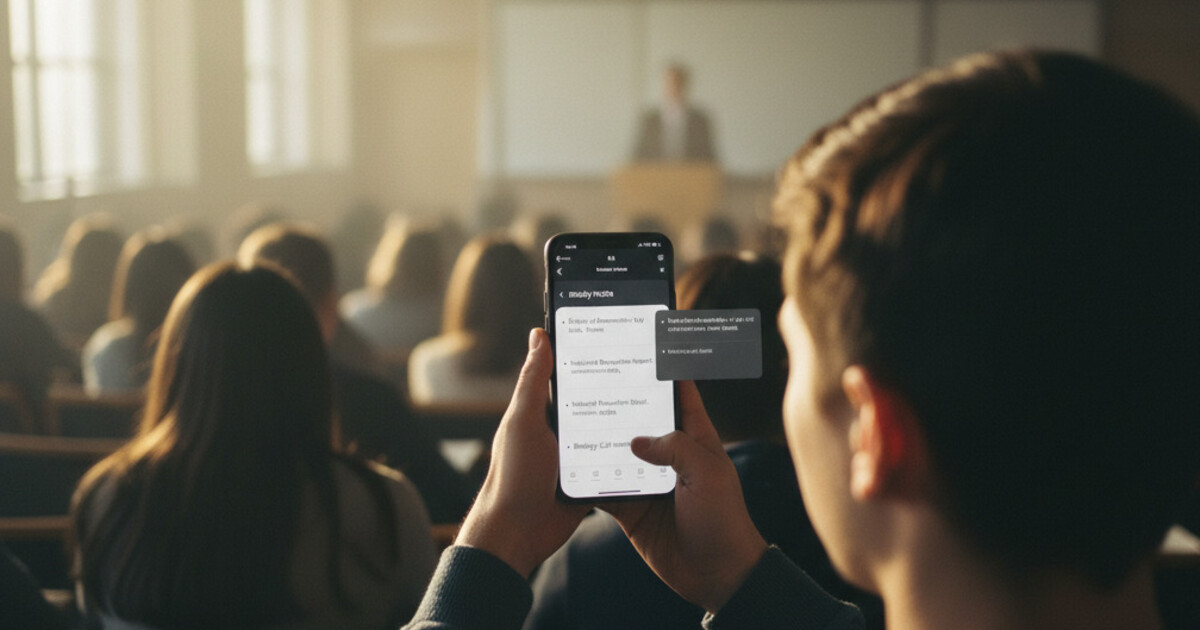
You recorded the lecture. You sat through two hours of slides. Now you're staring at 8 pages of scattered bullet points, half-finished sentences, and a margin full of question marks.
Getting those notes into a form you can actually study from takes work. Most students spend 30-45 minutes per subject just reorganizing and condensing what they captured in class. Across a 4-course semester, that's 2-3 hours every week on busywork before any real studying begins.
AI compresses that to minutes. This guide covers how to summarize lecture notes with AI, how the technology works, and how to get sharper study materials out of less effort.
To summarize lecture notes with AI, record your lecture, paste your written notes, or upload a PDF into an AI study tool. The AI extracts key concepts, strips filler, and organizes the material into a structured summary. Most tools process a full hour of content in under 2 minutes. The best ones also auto-generate flashcards and quizzes from the same source.
Why Manual Summarizing Eats Your Study Time
The average 1-hour lecture produces 4-6 pages of notes. Turning those into something you can study from means three separate cognitive tasks: reading and processing all the material, deciding what's important, and rewriting it in a clean format.
Students who do this by hand typically spend 30-45 minutes per lecture just on that condensing step, before any actual studying happens. For a full course load, that adds up fast.
The other issue: manual summarizing is mostly passive. Re-reading the same words doesn't force your brain to retrieve anything. Research consistently ranks passive re-reading as one of the least effective study techniques, sitting well below flashcards, practice tests, and self-quizzing on measurable retention outcomes.
So you spend significant time on something that doesn't move the needle. There's a better trade.
How AI Summarizes Lecture Notes
AI lecture summarizers work by processing the text or audio from your notes or recording, scanning for which concepts appear most frequently or in structural positions that signal importance (repeated explanations, definitions, anything the professor returns to), and compressing that content into an organized format.
Purpose-built study tools go further than basic text condensers. They strip conversational filler, group related ideas, and output summaries with clear topic headers instead of a wall of shortened text.
AI lecture note summarizers process your recording or written notes, identify recurring concepts and structural signals like repeated definitions and emphasized points, and compress the material into a structured summary with key topics organized clearly. Unlike basic summarizers, purpose-built study tools understand academic context well enough to separate a passing remark from a testable concept. Most tools process a full hour-long lecture in under 60 seconds. The output typically includes a structured summary by topic, highlighted key terms, and, in more capable apps, auto-generated flashcards and quiz questions built from the same source material. This matters because summarization alone doesn't produce long-term retention. When the AI immediately converts your summary into flashcards and practice questions, you can shift straight from passive review to active recall in one session. Students who combine AI summarization with immediate self-testing consistently retain more than those who only read summaries, a pattern supported by decades of testing effect research.
How to Summarize Lecture Notes with AI: Step by Step
The process varies slightly depending on whether you're starting from an audio recording or written notes.
Starting from a recording:
- Open your AI study app and tap to start recording, or import a saved audio file from a previous class
- Let the AI transcribe and process the audio (most apps finish a 60-minute lecture in 1-2 minutes)
- Review the auto-generated summary for accuracy and completeness
- Add any context the AI missed, especially anything your professor circled back to near the end
- Use the summary as your base for a flashcard or quiz session
Starting from written notes:
- Paste your notes into the AI tool
- Specify what output you want (summary only, key terms, or full flashcard set)
- Review the output and check it against the concepts you know are being tested
- Export or save the summary to wherever you study
One step most students skip: a quick review pass right after the AI finishes. The output will be accurate for standard content, but AI tools don't know which three topics your professor mentioned will be on the midterm. A 5-minute scan while the lecture is still fresh catches anything worth pulling back in.
For deeper background on how to turn lecture recordings into study notes before they hit an AI tool, that guide covers manual and hybrid approaches as well.
How NoteHive AI Handles Summarization Automatically
NoteHive AI handles the full process in one place. You tap to record your lecture, and when class ends, the app generates structured notes with key concepts organized by topic, automatically, without any copy-pasting.
From that same recording, NoteHive also creates auto-generated flashcards and quiz questions. So instead of summarizing your notes and then separately building study materials, you leave class with a summary, a flashcard deck, and a quiz already built and ready to use.
A few things worth knowing:
The app supports 80+ languages. Students attending lectures in Spanish, French, Mandarin, Arabic, or any other supported language can run the full workflow without switching to English. The transcription works across accents and pacing, which matters when audio quality isn't perfect.
There's also a web app at notehive.app/home for students who record on their phones but prefer studying on a laptop. Everything syncs.
NoteHive is built to be university-compliant. It processes and summarizes your lectures, but it doesn't answer exam questions or complete assignments. That's intentional, keeping it within academic integrity guidelines at schools that have strict AI policies.
Tips for Getting Better AI Summaries
The quality of your summary depends partly on the input quality. A few adjustments produce noticeably better output.
For recording-based summaries:
- Sit closer to the front when possible. Mic distance affects transcription accuracy more than most students expect.
- If your professor speaks quickly or has a strong accent, keeping your phone closer to the audio source helps.
- Don't worry about gaps or pauses. Brief silences don't break the summary.
For note-based summaries:
- Keep your original notes even loosely structured with paragraph breaks or headers. Structured input produces more organized output.
- Include the subject name or lecture topic at the top so the AI can apply relevant academic context.
- For sections you know are especially important, paste them as separate inputs. That way they don't get compressed as aggressively as filler material.
Once you have your AI summary, pair it with proven retention techniques. The article on spaced repetition vs active recall covers exactly which method to use depending on how close your exam is.
How an AI Note Summarizer Handles PDFs and Documents
Lectures aren't the only thing worth summarizing. Most students also deal with assigned readings: textbook chapters, journal articles, PDF handouts, or pages of dense course material that are just as hard to get through as a two-hour class session.
A good AI note summarizer handles all of it. Upload a PDF, a Word document, or plain text and the tool applies the same extraction logic it uses on audio: scanning for key terms, identifying structural signals, and compressing the material into organized notes. For a 20-page reading that would take 45 minutes to work through manually, that process takes under a minute.
NoteHive accepts PDF, DOCX, DOC, and TXT file uploads alongside audio and video recordings. The output format is the same as with lectures: structured notes with key concepts highlighted, plus flashcards and quiz questions generated from the document. Students dealing with heavy reading loads across multiple courses tend to find this more practical than audio-only tools, which only cover class time, not the hours spent on readings outside it.
For a broader comparison of standalone AI summarizer tools across different content types, the best AI summarizer for students guide covers the options by use case.
Frequently Asked Questions
Can AI accurately summarize an entire lecture?
Yes, for most academic content. Current AI tools handle standard lecture formats, definitions, and explanations accurately. They're less reliable for highly technical content with dense notation, like advanced calculus or chemistry reaction equations. For those courses, review and supplement the AI output manually.
How long does it take to summarize lecture notes with AI?
Most AI tools process a 60-minute lecture in under 2 minutes. Written notes paste in and get summarized in seconds. Compared to 30-45 minutes of manual summarizing, the time savings add up to several hours per week across a full course load.
Is summarizing lectures with AI cheating?
Using AI to summarize your own recorded lectures is generally treated as a study aid, not an academic integrity violation. The key distinction is that you're processing material from your own class attendance, not having AI complete assignments or answer exam questions. Always check your institution's specific policy on AI tools before using one.
What's the difference between a transcription app and an AI note summarizer?
Transcription apps convert audio to text. AI note summarizers process that transcription, extract key concepts, structure the material, and often generate study tools like flashcards and quizzes. NoteHive AI does both: it transcribes the lecture and then generates organized notes and study materials from the transcript in one workflow.
Can I summarize notes in languages other than English?
Yes, if the app supports multilingual processing. NoteHive supports 80+ languages, so students taking courses in Spanish, French, Mandarin, Arabic, or other languages can run the full summarization and study-material workflow without translating anything.
Conclusion
Summarizing lecture notes by hand is slow and, research shows, doesn't do much for retention. AI handles the organizational work in minutes, leaving your actual study time for methods that stick.
If you want a tool that covers the full pipeline, from recording your lecture to having structured notes, flashcards, and quizzes waiting for you, NoteHive AI handles all of it. Try it free at notehive.app.
Ready to transform your study sessions?
Start using NoteHive AI in your browser — turn your lectures into organized notes, flashcards, and quizzes. No download required.