
Is It Illegal to Record Someone? A Plain-Language Guide
Is It Illegal to Record Someone? A Plain-Language Guide
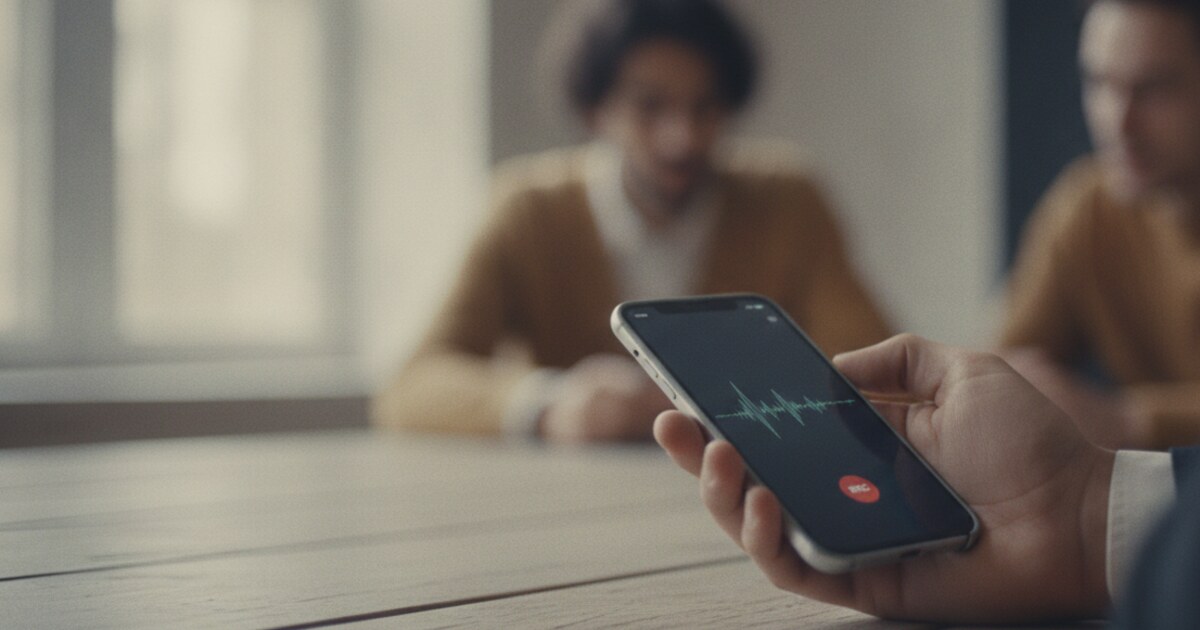
Most people pull out their phone to record a conversation without much thought. But is it illegal to record someone? The answer depends on where you are, who's in the conversation, and which state's laws apply. In some states it's a felony with up to 7 years in prison, so it's worth knowing the rules before you hit record.
In most of the U.S., recording a conversation you're part of is legal even without telling the other person. About 38 states and D.C. use "one-party consent" rules, meaning your own participation satisfies the consent requirement. Around 11 to 12 states require everyone in the conversation to agree before recording starts, and violating those laws can carry serious criminal penalties.
One-Party vs. Two-Party Consent: When Is Recording Illegal?
There's no single national recording law. Each state sets its own, and they vary widely.
One-party consent states allow any participant in a conversation to record it without telling the others. Your participation counts as consent. New York, Texas, Georgia, and Ohio all follow this model.
All-party (or two-party) consent states require everyone in the conversation to agree before recording starts. "All-party" is actually the more accurate term because in group calls or meetings, every person in the room needs to consent, not just two.
The federal Wiretap Act (18 U.S.C. § 2511) sits underneath all state laws. It defaults to one-party consent nationally, but states can layer stricter requirements on top. When they do, the stricter rule controls.
The U.S. recording consent framework splits into two camps. About 38 states plus Washington D.C. follow one-party consent, where any participant can record without notifying the others. The remaining 11 to 12 states require all-party consent, meaning everyone on the call or in the room must agree. Federal law under the Wiretap Act (18 U.S.C. § 2511) defaults to one-party consent, but states can build stricter requirements on top. When a call crosses state lines, say you're in Texas calling someone in California, courts generally apply the stricter standard and require everyone's consent. Penalties vary sharply. Pennsylvania classifies illegal recording as a third-degree felony with up to 7 years in prison. Florida carries up to 5 years. Illinois treats it as a Class 4 felony with fines reaching $25,000. Under the federal Wiretap Act, civil plaintiffs can sue for actual damages or statutory damages starting at $10,000 per violation. Beyond the legal consequences, illegally obtained recordings are generally inadmissible as evidence in court.
In What States Is It Illegal to Record Someone?
About 12 to 14 states require consent from everyone in the conversation. Laws shift as legislatures update them, so verify your state's current statute before relying on any list.
States generally considered all-party or multi-party consent states as of 2026 include: California, Connecticut, Delaware, Florida, Illinois, Maryland, Massachusetts, Michigan, Montana, Nevada, New Hampshire, Oregon, Pennsylvania, and Washington.
A few have specific nuances worth knowing. California's law (Penal Code § 632) applies to "confidential communications" and is among the most strictly enforced in the country. Pennsylvania's Wiretapping and Electronic Surveillance Control Act treats violations as a third-degree felony, making it one of the harshest recording laws on the books. Florida's statute covers both audio and certain video recordings.
If you're in a one-party state and calling or meeting with someone in an all-party state, use the all-party standard. Courts have generally applied the stricter state's law to interstate calls and meetings.
For students navigating recording rules in the classroom, see our full guide on recording lectures in college, which covers how university policies layer on top of state recording laws.
Do You Have to Tell Someone You're Recording?
This is the question that comes up most and gets the haziest answers online.
In one-party consent states: no, you don't have to tell the other person. Your participation in the conversation is the legal basis. Law enforcement, journalists, and private investigators in these states record conversations on exactly this basis.
In all-party consent states: yes, everyone needs to know before you hit record. But the disclosure doesn't need to be formal or written. Saying "I'm going to record this call, is that alright?" and getting a verbal yes generally works. Many businesses handle it automatically with a recorded prompt at the start of a call.
There's a widespread belief that recording disclosures need to follow a specific script. They don't. A clear verbal statement followed by the other person continuing the conversation is typically treated as implied consent in practice.
One important catch: even where state wiretapping law permits recording, other rules can still apply. School codes of conduct, employer policies, and contractual agreements can ban recording independently of what state law says. The law sets the floor; institutional rules can go higher.
For a deeper look at when recording without telling someone crosses an ethical line, read is it wrong to record a conversation?
Recording in Common Situations: Calls, Classes, and Public Spaces
The rules look different depending on the setting.
Phone and video calls. In one-party consent states, you can record any call you're part of without notifying anyone. In all-party states, everyone on the call needs to agree. For interstate calls, courts apply the stricter state's law. If you're unsure which state the other party is in, stating that you're recording is the safest approach.
In-person conversations. The same consent framework applies. In a one-party state, you can record a conversation you're part of. In an all-party state, get verbal agreement first. Setting matters too: a private office or home carries a higher expectation of privacy than a crowded coffee shop.
Public spaces. Recording in a public place is broadly protected under the First Amendment. Police officers on duty, bystanders in public areas, and any activity visible from a public space can generally be recorded without consent. The limits start when you move into private settings or deliberately capture someone in a place they reasonably expect to be unobserved, like a bathroom or a bedroom window.
Classrooms and lectures. Most one-party consent states permit recording a class you're attending. But universities often layer their own restrictions on top, requiring professor permission even where state law wouldn't. Some schools treat recording without consent as a violation of the student code of conduct, regardless of the local law. Check your school's policy before recording. We cover how consent rules apply in educational settings in is it illegal to record a conversation?
Workplace conversations. Recording your own work conversations is typically covered under one-party consent. A few states have exceptions for purely covert employee surveillance, but recording your side of a meeting or performance review is generally the cleaner legal path for documentation.
How NoteHive Helps You Record Lectures Legally
Once you've confirmed that recording is permitted, the practical problem shifts from legality to usefulness. A phone propped on a desk at the back of a 200-seat lecture hall often produces audio you can barely follow later.
NoteHive is a web app that takes recorded audio and turns it into actual study materials. Record a lecture directly in the browser, upload an existing audio or video file, or drop in a document, and NoteHive transcribes it and generates organized notes, flashcards, and a practice quiz automatically. No install required.
For students in one-party consent states, or anywhere you've got the professor's sign-off, NoteHive carves out something useful from a permitted recording. The app supports 80+ languages, so international students can record in the course language and review notes in their native one.
NoteHive is built around academic use: it processes recordings into study materials but won't write assignments, answer exam questions, or assist with anything that would conflict with your school's honor code. Fully compliant with university academic integrity policies.
Start studying smarter free at notehive.app. Record a lecture and get AI-generated notes, flashcards, and a practice quiz in under 2 minutes.
Frequently Asked Questions
Can you record someone in public without their permission?
Generally yes. In public spaces where people don't have a reasonable expectation of privacy, recording is protected under the First Amendment. This covers recording police officers performing public duties, street conversations, and public events. The limits start at private settings: recording someone through a window into their home, in a restroom, or anywhere they reasonably expect to be unobserved remains illegal regardless of state consent rules.
In what states is it illegal to record someone without consent?
States generally requiring all-party or multi-party consent include California, Connecticut, Delaware, Florida, Illinois, Maryland, Massachusetts, Michigan, Montana, Nevada, New Hampshire, Oregon, Pennsylvania, and Washington. In these states, recording a private conversation without everyone's agreement can result in criminal charges. Recording laws change periodically, so check your state's current statute before recording.
What happens if you record someone illegally?
Criminal penalties vary by state. Pennsylvania and Florida classify illegal recording as a third-degree felony with potential prison terms up to 7 and 5 years respectively. Illinois allows up to 3 years and $25,000 in fines. Under the federal Wiretap Act, victims can sue for actual damages or a minimum of $10,000 in statutory damages per violation. An illegally obtained recording is also typically inadmissible as evidence in any court proceeding.
Do you have to tell someone if you're recording them?
In one-party consent states, no. Your participation in the conversation satisfies the legal requirement. In all-party consent states, everyone needs to agree before recording starts. For phone calls, a verbal disclosure followed by the other person continuing the call is typically treated as consent. In formal settings or legal disputes, getting written acknowledgment is safer.
Can someone record a video of me without my permission?
It depends on the setting. Recording video in public spaces is generally legal. If the recording captures a private setting, includes audio of a private conversation, or involves an intimate situation, wiretapping laws and voyeurism statutes both apply regardless of state consent rules. Some states have specific laws on video voyeurism that go beyond basic audio recording protections. A stranger filming you on a public sidewalk is typically legal. Filming through your window is not.
Ready to transform your study sessions?
Start using NoteHive AI in your browser — turn your lectures into organized notes, flashcards, and quizzes. No download required.