Flashcard Study Methods: Are Flashcards Effective?
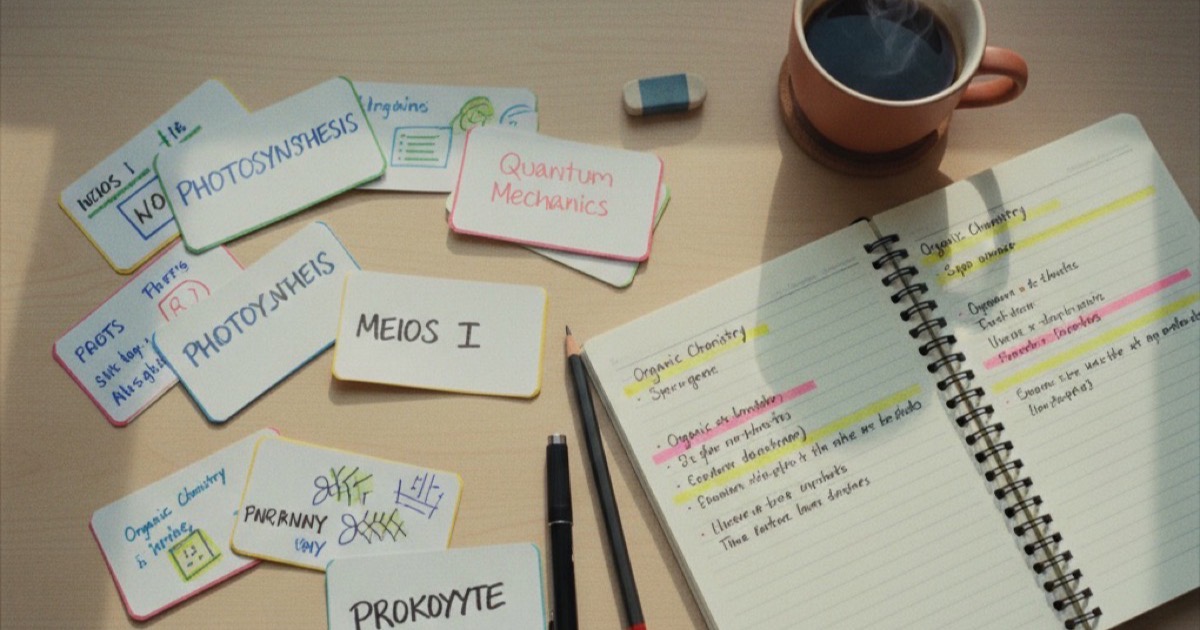
The debate over flashcards vs notes comes up in every study skills forum, every college orientation, every Reddit thread before finals. Both camps have loud defenders. Both are partially right. The real answer is that each method has a different job, and understanding which to use when will change how you prepare for every exam.
Flashcard study works because it forces active recall: your brain retrieves information from memory rather than passively recognizing it on a page. Research shows this retrieval practice produces roughly 50% better long-term retention than re-reading. For fact-heavy subjects like medicine, law, or language learning, flashcards consistently outperform notes-only approaches. For conceptual understanding, notes win.
Are Flashcards Effective? What the Research Shows
Yes, flashcards are effective, under the right conditions. They're built around two of the strongest learning mechanisms in cognitive science: active recall and spaced repetition.
Active recall means pulling information out of memory rather than recognizing it. Every time you flip a card and try to answer before seeing the back, you trigger a retrieval attempt. Successful or not, that attempt strengthens the memory trace. Passive re-reading doesn't do that.
Research supports flashcard study as one of the most efficient memorization strategies available. Karpicke and Roediger (2008) found that retrieval practice via flashcards produced 50% better long-term retention compared to repeated study sessions. A 2025 study in Anatomical Sciences Education found undergraduate medical students using electronic flashcards scored significantly higher on musculoskeletal assessments than those using traditional notes alone. Brainscape's analysis of learning efficiency found that active recall, the core mechanism behind flashcards, produces roughly 150% better retention than passive review. The mechanism is direct: each time you flip a card and recall an answer, you strengthen that memory trace. Each failed recall shows exactly which concepts need more repetition. Spaced repetition algorithms extend this advantage by scheduling reviews at the optimal interval before forgetting occurs, typically increasing retention efficiency by 2x over massed practice. The combination of active recall and spaced repetition makes flashcard study particularly powerful for any subject requiring fast, accurate fact retrieval under exam conditions.
The caveat is real: flashcards lose their edge when exams test application rather than recall. If you need to write an essay, solve a proof, or debug code, flashcards alone won't carry you. That's where notes come back in.
The Science of Note-Taking
Taking notes during a lecture activates several cognitive processes at once. Writing information helps your brain encode it; organizing it into headings and bullets creates mental frameworks for understanding; and the result is a personalized reference you can review later.
The problem is execution. Students typically capture only 20-40% of lecture content in their notes. Even when the notes are comprehensive, most students review them passively, re-reading without testing themselves. That's where memory formation stalls.
Notes build the mental scaffolding that makes flashcards useful later. If you don't understand how a concept fits into the bigger picture, you'll struggle to create or answer meaningful flashcard prompts. Conceptual understanding has to come first.
Where notes clearly win:
- Complex concepts where relationships between ideas matter
- Logical arguments and step-by-step processes
- First exposure to new material (notes help you build the foundation)
- Essay-based exams that test reasoning and structure, not just recall
When Flashcard Study Outperforms Notes
Flashcards earn their reputation in specific situations.
Where flashcard study clearly wins:
- Memorizing facts, definitions, and vocabulary
- Multiple-choice exam prep where fast recall is the skill being tested
- Foreign language acquisition (vocabulary and grammar rules)
- Medical and science courses loaded with terminology
- Any subject where you need to recognize or produce the correct answer quickly
The timing matters too. Flashcards shine in the middle and late stages of studying, after you've used notes to build initial understanding. Using flashcards before you understand the material produces a frustrating grind: you're trying to memorize things you haven't yet made sense of.
The Best Approach: Combine Both
The strongest students don't choose between the two methods. They run them in sequence.
Step 1: Capture everything (notes)
During lectures, focus on comprehensive notes. NoteHive AI handles this automatically: the app records and transcribes your entire lecture into organized, structured notes without you having to type.
Step 2: Generate flashcards from your notes
Pull the key facts, definitions, and formulas from your notes and turn them into flashcards. NoteHive AI does this automatically, identifying the most important concepts from your lecture. See the step-by-step walkthrough on auto-generating flashcards from lectures for how it works.
Step 3: Study in layers
- First pass: review your notes to understand the big picture
- Second pass: work through flashcards to lock in key details
- Third pass: take practice quizzes to test your understanding under pressure
- Ongoing: use spaced repetition with flashcards for long-term retention
This layered approach pairs well with the principles in spaced repetition vs active recall. Understanding why each technique works helps you apply them at the right moment in your study cycle.
Study Method Comparison
| Factor | Notes Only | Flashcards Only | Both (with AI) |
|---|---|---|---|
| Time to create | High | Very High | Low (automated) |
| Conceptual understanding | Strong | Weak | Strong |
| Fact memorization | Moderate | Strong | Strong |
| Exam readiness | Moderate | Moderate | High |
| Long-term retention | Moderate | Strong | Very Strong |
The combined approach dominates across every dimension. The reason most students don't use it is time: building good notes and a solid flashcard deck from the same lecture manually takes hours. AI removes that friction entirely.
How NoteHive Turns Your Notes Into Flashcards
With NoteHive AI, you record your lecture once. From that single recording, the app generates:
- Organized notes with key concepts structured and highlighted
- A flashcard set built from the most important material
- Practice quizzes to test your understanding
- An audio summary you can listen to on your commute
You get the benefits of both study methods without the manual work of creating either from scratch. The flashcards come directly from your notes, so the conceptual scaffolding and the recall practice are built from the same source.
This is different from using separate apps for notes and flashcards. When your notes and cards come from the same session, they reinforce each other. Studying the cards sends you back to the right section of the notes when a concept doesn't click. The notes give context; the cards build the retrieval habit.
Frequently Asked Questions
Is flashcard study better than re-reading notes?
For memorizing facts, definitions, and formulas, flashcard study outperforms passive note re-reading. Retrieval practice produces around 50% better long-term retention. Notes stay more useful for conceptual understanding and essay-based topics where structure and argument matter more than raw recall.
Are flashcards effective for all subjects?
Flashcards work best for terminology-heavy subjects: medicine, biology, law, foreign languages, and chemistry. They're less effective when exams require applying concepts rather than recalling them. Most students benefit from using both methods: notes for understanding, flashcards for memorization.
How many flashcards should I study per day?
Most spaced repetition systems recommend 20-50 new cards per day. Anki's default is 20 per day. Consistency matters more than volume: daily 15-minute sessions beat a 3-hour weekend marathon, because each review reinforces the memory at the right interval before forgetting sets in.
When do flashcards not work well?
Flashcards struggle with open-ended essays, mathematical proofs, coding problems, and topics where applying knowledge matters more than recalling it. If your exam tests analysis, synthesis, or creative reasoning, add practice problems and outline-based notes to your flashcard routine.
Can I automatically create flashcards from my lecture notes?
Yes. NoteHive AI records your lecture, generates organized notes, then builds flashcards and practice quizzes automatically. You get the full study pipeline from one recording session, without writing a card manually.
Combining notes and flashcards gives you the conceptual depth of one method and the retention power of the other. If time is the barrier, try NoteHive free at notehive.app. Record a lecture and get AI-generated notes, flashcards, and a practice quiz in under 2 minutes.
Ready to transform your study sessions?
Start using NoteHive AI in your browser — turn your lectures into organized notes, flashcards, and quizzes. No download required.