Best Note-Taking App for Pre-Med Students in 2026
Best Note-Taking App for Pre-Med Students in 2026
Finding the best note-taking app for pre-med students starts with understanding what pre-med coursework actually demands. Biochemistry pathways, pharmacological mechanisms, histology slides, anatomy structures, and statistical models for epidemiology all land in the same semester. The volume of factual content isn't just high; it needs to stick for months or years, not just until the next midterm. The MCAT tests material from courses taken in freshman year. That changes how you need to study from the start.
Most note-taking apps solve for capturing information during class. Pre-med students need tools that go further: turning lecture content into review-ready study materials fast, reinforcing retention over weeks and months, and handling the diagram-heavy subjects that can't be captured with text alone.
This guide covers the 5 best note-taking apps for pre-med students in 2026, along with what each one actually does well.
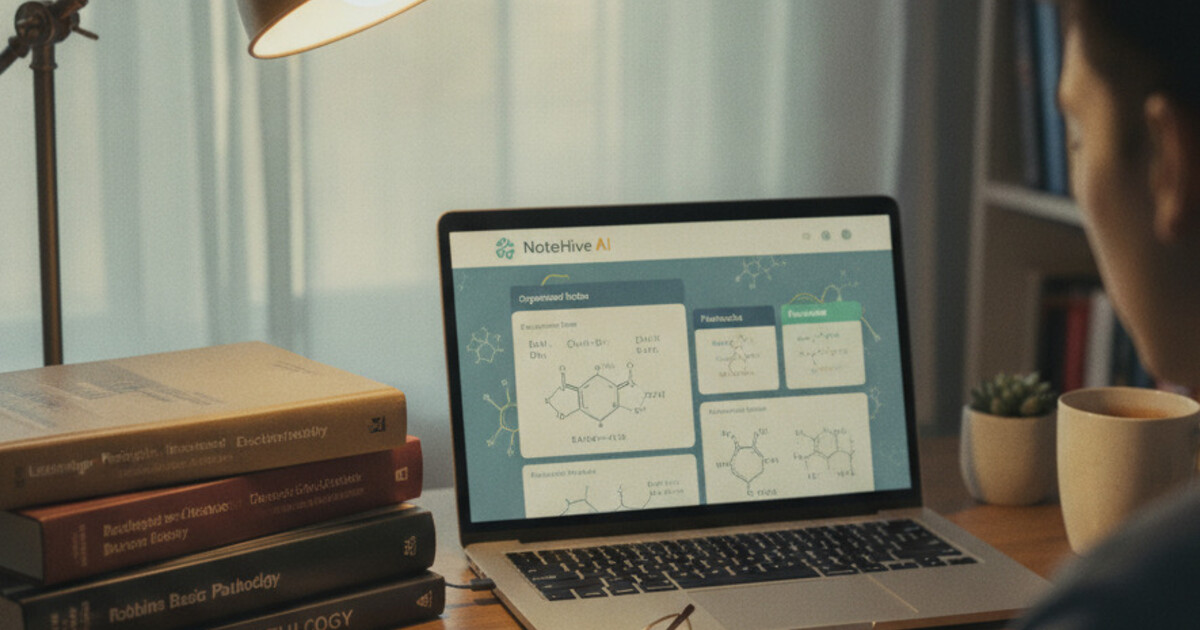
The best note-taking app for pre-med students is NoteHive AI. It records lectures and converts them into organized notes, auto-generated flashcards, and a practice quiz automatically. For pre-med students managing 15-18 credit hours of science-heavy coursework, getting study materials built without extra manual work means more time goes toward actual review.
Why Pre-Med Note-Taking Is Different
The core challenge isn't capturing information during class. It's processing enough of it, deeply enough, to recall it under exam conditions months later.
Pre-med students typically carry 5-6 science courses per semester covering biology, chemistry, organic chemistry, biochemistry, physics, and anatomy or physiology depending on year. Each course runs 2-3 lectures per week, each introducing 30-60 new concepts, mechanisms, or vocabulary terms. A 2008 study in Science by Karpicke and Roediger found that students using active recall after studying retained 50% more material one week later than students who restudied passively. That gap widens at the 6-month mark, when MCAT prep is underway and freshman-year content competes with sophomore-year material for working memory. According to AAMC data, most pre-med students need 300-500 hours of dedicated MCAT preparation across 3-6 months. Students who build active recall habits during coursework rather than during a concentrated prep sprint reach that phase with a substantially smaller gap to close. Research by Deng et al. (2019) in medical education showed retention rates at 3 months that were 40% higher for students using spaced repetition review vs. traditional restudy. Building those habits early matters more than any single study session.
Any note-taking system that leaves flashcard creation and review-material prep as separate manual tasks adds 30-60 minutes of work per lecture. That overhead compounds across 10-15 lectures per week across a full pre-med schedule.
The 5 Best Note-Taking Apps for Pre-Med Students in 2026
1. NoteHive AI: Best Overall for Pre-Med Students
NoteHive AI handles the full study pipeline from a single recording. Tap record when biochemistry lecture starts. By the time you finish a 3-hour chemistry lab the same afternoon, you have organized notes from the morning's lecture, auto-generated flashcards for the key mechanisms, and a practice quiz ready to run.
The notes-to-podcast feature is underused by most students but fits pre-med schedules particularly well. Long explanations of metabolic pathways, enzymatic cascades, and pharmacokinetic principles translate cleanly to audio. You can listen during a commute, a gym session, or while cooking dinner. That's time most pre-med students aren't using academically. With a 20-minute audio summary of the day's physiology lecture loaded on your phone, a 30-minute gym session becomes a review session.
Flashcard generation is automatic. NoteHive identifies key concepts from your lecture recording and generates cards without manual building. For anatomy and physiology terms, biochemistry mechanisms, or pharmacology drug classes, this is the biggest time saver in the workflow. Pre-med students who want to understand how to stack this with other review methods will find the spaced repetition vs active recall guide useful.
NoteHive supports 80+ languages, relevant for international pre-med students or anyone with coursework involving foreign-language source material. It works in any browser with no installation required. The free tier covers recording, note generation, flashcards, and quizzes with no credit card needed.
2. Anki: Best for Long-Term Retention and MCAT Prep
Anki is the standard tool in pre-medical education for good reason. Its spaced repetition algorithm schedules card reviews right before the threshold for forgetting, producing measurably better retention at 3 and 6 months vs. standard restudy approaches.
For pre-med students, the biggest advantage is the pre-built deck ecosystem. Anki's community has produced high-quality decks for nearly every pre-med subject: AnKing's comprehensive medical deck, Zanki for biochemistry and pharmacology, BioDecks for biology, and dedicated MCAT content decks aligned to the current test blueprint. These represent hundreds of hours of curation by students who completed the same courses.
The tradeoff is setup cost for custom material. When a professor teaches from their own slides or covers topics outside existing decks, building cards manually takes time. Anki works best in combination with a tool that automates card creation from your own recordings, then reserves Anki's manual workflow for pre-existing, curriculum-matched decks. Building an MCAT-specific Anki deck gradually across two years is more effective than trying to absorb the same content during a 3-month prep sprint.
3. Otter AI: Best for Dense Lecture Transcription
Otter AI produces searchable, timestamped transcripts of lectures. For pre-med courses where a professor mentions a specific mechanism in passing and you need to find exactly what was said, keyword search through the full transcript is faster than scrubbing audio for 10 minutes.
Speaker identification handles multiple voices well, which matters in discussion-based classes or case presentations where faculty and students alternate. The automatic labels tell you who said what.
The limitation is that a transcript is a raw record. Otter stops at the text output. Getting from a lecture transcript to flashcards and a self-test quiz still requires manual work on the other end. For courses where your main need is checking what was said verbatim, Otter covers that use case well. For building full study materials, the workflow needs to continue further.
4. Notability: Best for Anatomy Diagrams and Lab Notes
Notability is built for the Apple Pencil. For anatomy and histology, drawing structures by hand produces better spatial retention than labeling printed diagrams, and Notability's drawing tools are precise enough for the work.
The audio sync feature is useful in lab settings. Tap any point in your handwritten notes and hear the audio from that exact moment, which helps reconstruct what an instructor explained while demonstrating a dissection technique or identifying a tissue sample.
The requirements are real: Notability needs an iPad and Apple Pencil. There's no AI-generated content, no flashcard output, no quiz generation. For visual-spatial subjects where hand-drawing is genuinely how you learn the material, Notability is the right tool. For text-heavy lecture content where flashcards and active recall are the goal, the other apps on this list handle that more efficiently. The how to take better notes in college guide covers when handwritten notes outperform typed notes, which is relevant for anyone deciding whether to carry an iPad.
5. Notion: Best for Organizing Research Notes and Clinical Logs
Pre-med students accumulate material that doesn't fit into a lecture structure: professor office hours notes, research lab observation logs, clinical shadowing reflections, volunteering records, and activity lists for medical school applications. Notion handles unstructured, varied content in a way that linear note apps don't.
Database views let you sort shadowing hours by specialty, date, or clinic. Linked pages connect a physiology concept from a shadowing observation back to your biochemistry notes from lecture. For the organizational layer of pre-med, where you're tracking coursework, research, extracurriculars, and application materials simultaneously, Notion provides structure that folders and files don't.
The limitation is that Notion is an organizer, not a study machine. There's no lecture recording, no AI note generation, no flashcard or quiz output. It complements the rest of your study stack rather than replacing it.
How to Build a Pre-Med Study System
A few patterns that hold up across heavy-content semesters:
Record every lecture: Use NoteHive to capture and auto-process lectures rather than relying on handwritten notes being complete during a fast-paced biochemistry class. A recording plus AI organization gives you a reliable, searchable reference.
Run the practice quiz within 24 hours: The how to summarize lecture notes with AI guide covers why spacing the first review within a day of learning produces better long-term retention. Pre-med students who run a quick quiz the same evening retain substantially more than those who wait until the weekend.
Move MCAT content into Anki: When a concept appears in coursework and it's MCAT-relevant, add it to a dedicated Anki MCAT deck, or find an existing card in AnKing. Building that deck gradually across 2 years is more effective than trying to learn it all during prep season.
Reserve Notability for anatomy and lab: Diagram-based subjects benefit from hand-drawing. Use Notability there and NoteHive everywhere else.
Use audio review for commutes and gym sessions: Queue up NoteHive podcast summaries of recent lectures. Three to four hours per week of audio review across a semester adds up to 60+ hours of content exposure that most students don't capture.
Frequently Asked Questions
What's the best note-taking app for pre-med students?
NoteHive AI is the best overall option for pre-med students. It records lectures and automatically converts them into organized notes, flashcards, and practice quizzes, covering the full study pipeline without requiring manual conversion work after class. The notes-to-podcast feature adds audio review for commutes and gym sessions.
Do pre-med students need Anki?
Anki is genuinely useful for pre-med, especially for MCAT preparation. Its spaced repetition algorithm produces measurably better long-term retention than traditional restudy. Pre-med students who start building subject-specific Anki decks during coursework, rather than waiting until dedicated MCAT prep, enter the prep phase with substantially less ground to cover. Pairing Anki with NoteHive handles both automated review (NoteHive's quizzes) and long-horizon spaced repetition (Anki's SRS).
Can NoteHive handle biochemistry and anatomy lectures?
Yes. NoteHive transcribes lecture audio and identifies key concepts for note organization and flashcard generation regardless of subject matter. For anatomy, where diagram labeling matters, pairing NoteHive for audio and concept-based content with Notability for hand-drawn structures covers both types of learning.
Is NoteHive AI free for pre-med students?
NoteHive's free tier covers lecture recording, AI-organized notes, flashcard generation, and practice quizzes with no credit card required. Premium unlocks unlimited recordings for students with heavier course loads across a full pre-med schedule.
Pre-med students carry some of the densest course loads in undergrad, and the gap between studying for next week's exam and studying for the MCAT makes every review session count twice. Start organizing your notes free at notehive.app: record a lecture and get AI-generated notes, flashcards, and a practice quiz in under 2 minutes.
Ready to transform your study sessions?
Start using NoteHive AI in your browser — turn your lectures into organized notes, flashcards, and quizzes. No download required.