Best Note-Taking App for Nursing Students in 2026
Best Note-Taking App for Nursing Students in 2026
Nursing school is dense in a way that's hard to describe until you're in it. A single pharmacology lecture might cover 15 drug classes, each with mechanisms of action, side effects, contraindications, and nursing implications. Anatomy and pathophysiology add another layer of precise terminology. Clinical rotations cut into study time, and NCLEX prep runs in the background through all of it.
Taking notes manually during a fast-moving nursing lecture means choosing between writing and understanding. You can't do both at full speed. And once the lecture ends, converting raw notes into usable study material, flashcards, practice questions, review summaries, takes hours that most nursing students don't have.
This guide covers the 5 best note-taking apps for nursing students in 2026, with a focus on tools that go beyond capturing text and actually help you study.
The best note-taking app for nursing students is NoteHive AI. It records lectures and converts them into organized notes, auto-generated flashcards, and a practice quiz automatically. For nursing students covering pharmacology, anatomy, and pathophysiology every week, that pipeline cuts the gap between attending class and having ready-to-study materials to under 2 minutes per lecture.
Why Nursing Students Need More Than Basic Notes
Most note-taking apps solve half the problem. They capture what was said in class. The harder half is converting those notes into something you can actually study from: flashcards for drug names and mechanisms, practice questions to test your clinical reasoning, audio summaries to review during a commute to your clinical site.
Nursing students face a volume problem that most other programs don't. In a typical nursing program, students work through more than 1,500 medications across the full curriculum, each requiring memorization of mechanism, indications, side effects, and nursing implications. Anatomy and pathophysiology add several thousand more terms. Educational psychology research consistently shows that active recall methods, including self-testing, flashcard drilling, and practice questions, lead to significantly better retention than passive review like rereading notes. For nursing students, this matters directly: NCLEX prep rewards students who've tested themselves consistently throughout the program, not those who crammed at the end. The challenge is that building active recall materials from scratch, writing flashcards, creating practice questions, organizing summaries, takes 60-90 minutes per lecture on top of class time. That time pressure is why automated tools matter in nursing programs specifically. Apps that record lectures, organize notes, and generate study materials give students more time for the practice that drives actual retention.
A basic text-capture app handles the first step and leaves everything else to you. A tool that covers the full pipeline, from audio to organized notes to flashcards to quizzes, is a different category of resource for nursing students.
The 5 Best Note-Taking Apps for Nursing Students in 2026
1. NoteHive AI: Best Overall for Nursing Students
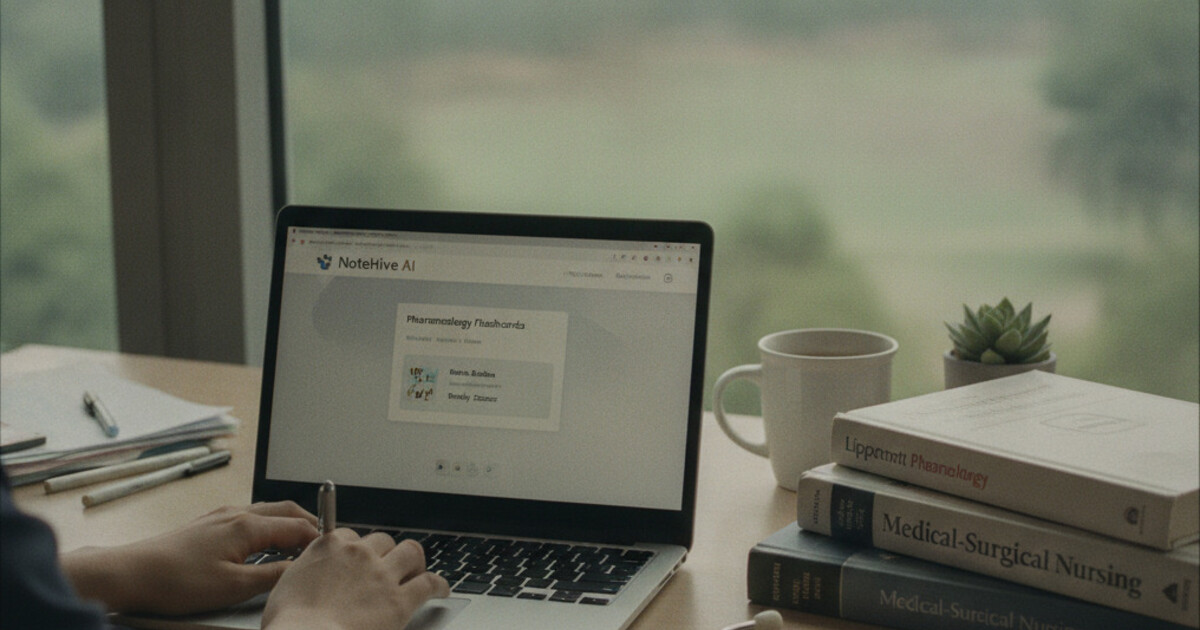
NoteHive AI covers the full study pipeline in one place. Tap record when the pharmacology lecture starts, and by the time class ends you have organized notes, auto-generated flashcards for the drugs covered, and a practice quiz built from those notes.
For nursing students, the flashcard generation is the most useful feature. Pharmacology is largely a memorization problem: drug names, drug classes, mechanisms of action, side effects, nursing implications. NoteHive's auto-flashcard feature pulls that structure from your notes automatically, saving the 30-40 minutes it typically takes to write cards by hand after each lecture.
The quiz generation is a close second. Running a quick quiz after each lecture, while the material is fresh, is active recall built into your workflow at the point when it does the most good. You don't have to wait until exam week to find out what didn't stick.
The notes-to-podcast feature fits the nursing student schedule well. Convert your pharmacology notes into audio and listen during the drive to your clinical site. Review anatomy on a commute or during a workout. It turns blocks of time that would otherwise go unused into study sessions without adding another hour to your day.
NoteHive supports 80+ languages, which helps international nursing students or anyone taking courses with multilingual content. It works in any browser with no installation required. The free tier covers recording, note generation, flashcards, and quizzes with no credit card needed.
2. Osmosis: Best for Visual Learning
Osmosis is designed specifically for health sciences students. Its library of anatomy diagrams, pathophysiology illustrations, and clinical condition explainers is genuinely hard to match for visual learners who process complex body system content better with images than with text.
The downside is cost. Osmosis is subscription-based and sits on the pricier end of student apps. It's also primarily a curated content library rather than a tool that processes your own lecture notes. You're learning from Osmosis's materials, not from what your professor actually said in class, which may or may not map to your program's approach.
For visual learners who want a complement to their regular note-taking tool, Osmosis adds real value. As a standalone study system, it leaves a gap where your actual lecture content should live.
3. Anki: Best for Pharmacology Drilling
Anki is the classic spaced repetition flashcard system. In nursing programs, it's most common among students grinding through pharmacology: they build or download decks covering drug mechanisms and side effects, then let Anki's algorithm schedule reviews at optimal intervals.
The learning curve is real. Building cards properly, with cue-response pairings that support clinical reasoning rather than rote memorization, takes skill and time. Pre-built nursing decks exist and vary widely in quality. Anki also does only flashcards: there's no recording, no automatic note organization, and no quiz generation beyond the card format.
If you're willing to put in the setup time, Anki is one of the most effective tools available for the specific problem of memorizing pharmacology. If you want a tool that handles more of the pipeline automatically, NoteHive covers the flashcard generation as part of a broader workflow.
For a comparison of flashcard tools available to nursing students, the best AI flashcard maker for students guide covers the current options.
4. Otter AI: Best for Accurate Transcription
Otter AI produces word-for-word transcripts with high accuracy, including speaker identification. In seminars or case discussion classes with multiple speakers, Otter handles the complexity well and lets you search the full transcript for specific terms after class.
Where it falls short for nursing students is the conversion step. Otter gives you a transcript. Getting from that transcript to organized notes, flashcards, and practice questions still falls to you, and that's the most time-consuming part of the study workflow.
If your primary need is an accurate, searchable record of what was said in class, Otter is a good choice. If you need that record to also become study materials without additional manual work, you'll want a tool that continues past transcription.
5. Notability: Best for Handwritten Notes and Lab Diagrams
Notability is a tablet-based app built for the Apple Pencil. For anatomy lab sketches, ECG interpretations, or clinical diagrams, drawing by hand rather than typing is often faster and more precise. Notability syncs across Apple devices and lets you record audio alongside handwritten notes, so you can replay what was being said at any specific point in your notes later.
The limitation is hardware: Notability requires an iPad and Apple Pencil, which is a real cost commitment. There's no AI note generation, no automatic flashcard output, and no quiz generation. For clinically complex visual content, it earns its place. For lecture content heavy with terminology and drug information, other tools on this list handle the downstream study conversion that Notability doesn't.
How NoteHive AI Fits the Nursing School Study Cycle
The complete loop in nursing school goes: attend class, review lecture content, build study materials, test yourself, review weak spots. Most apps cover one or two steps in that cycle. NoteHive covers all of them.
Recording a pharmacology lecture and getting organized notes, flashcards, and a quiz in under 2 minutes is a meaningfully different experience from rereading messy handwritten notes and spending an hour building Anki cards by hand afterward.
The spaced repetition principle works best when you actually do the reviews consistently. The more friction you remove from building the review materials in the first place, the more likely you are to do the active recall practice that drives retention. The spaced repetition vs active recall guide covers why that difference matters for high-volume content like pharmacology.
NoteHive is university-compliant. It records and organizes your notes, but it doesn't complete assignments, answer exam questions, or help with academic dishonesty in any form. That's important in nursing programs where academic integrity standards are strict.
Study Habits That Work Alongside AI Note-Taking
A few patterns that make AI note-taking more effective for nursing students:
Review generated notes the same day. AI-organized notes are accurate, but your own memory of the surrounding context fills in gaps. A 10-15 minute same-day review lets you catch anything that needs clarification before it buries itself in your memory.
Run the quiz right after studying, not before the exam. Testing yourself after each lecture shows which concepts didn't stick while you still have time to revisit them. That's a better signal than rereading notes and thinking "I feel like I got this."
Build audio review into your clinical commute. Convert your notes to audio and listen on the drive to your clinical site or during a workout. For heavy memorization content like pharmacology, spaced exposure over multiple days matters more than one long cramming session.
Supplement with a pharmacology-specific deck if needed. NoteHive's auto-flashcards cover what your professor said in class. For comprehensive pharmacology drilling beyond your specific lecture content, a dedicated Anki deck focused on drug categories can fill in the gaps.
The how to study for nursing school guide goes deeper on study strategies built around nursing programs' specific demands, and the wider best study apps for college students roundup compares the flashcard, quiz, and planner tools that pair well with a note-taking app.
Frequently Asked Questions
Is NoteHive AI free for nursing students?
Yes. NoteHive has a free tier at notehive.app/onboarding that covers lecture recording, AI-generated organized notes, flashcard generation, and practice quiz creation with no credit card required. Premium adds unlimited recordings, but the free tier covers a full week of nursing classes without spending anything.
Can NoteHive generate NCLEX-style practice questions?
NoteHive generates quizzes from your own lecture notes, testing your recall of what was covered in class. NCLEX prep involves a specific clinical reasoning question format that standardized resources like ATI and UWorld are built for. NoteHive is strongest for lecture-based content review. NCLEX-format question practice works best from a dedicated resource alongside it.
Does NoteHive work for nursing pharmacology specifically?
Yes. Pharmacology lectures are dense with drug names, mechanisms, and clinical implications, and NoteHive's AI organization and auto-flashcard generation handle that content well. The flashcards pull key terms and drug-related information from your recordings automatically, which is exactly the repetitive memorization work pharmacology requires.
Can I use NoteHive during clinical rotations?
NoteHive records audio from your device, so it's primarily useful for lecture-based content. During clinical rotations you won't typically be recording patient care sessions. The most practical rotation-time use is converting lecture notes to audio and listening to them during your commute to the clinical site.
Will my nursing program allow AI note-taking apps?
Most do. Recording lectures for personal study is standard practice at most nursing schools, and NoteHive is fully compliant with academic integrity standards. It captures and organizes your own notes but doesn't complete assignments, answer exam questions, or assist with cheating in any form. Check your specific program's recording policy before the first day of class.
Nursing school asks a lot. Cutting the time between attending a lecture and having ready-to-study materials is one of the few places you can genuinely get hours back. Start organizing your notes free at notehive.app — record a lecture and get AI-generated notes, flashcards, and a practice quiz in under 2 minutes.
Ready to transform your study sessions?
Start using NoteHive AI in your browser — turn your lectures into organized notes, flashcards, and quizzes. No download required.