Best Note-Taking App for Engineering Students in 2026
Best Note-Taking App for Engineering Students in 2026
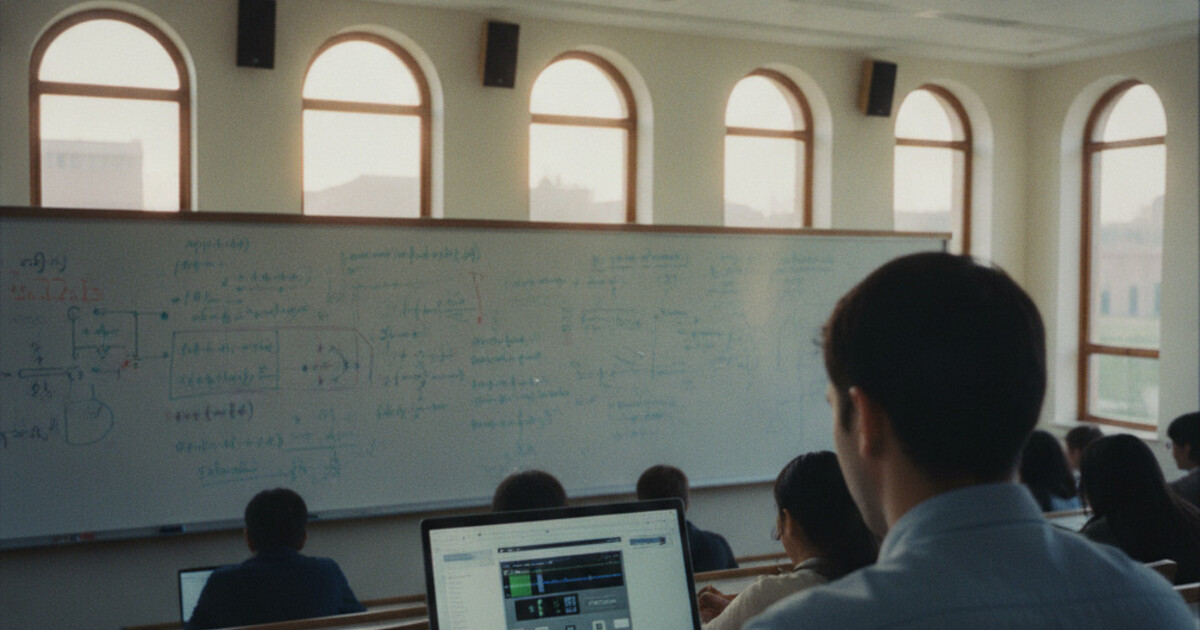
Engineering lectures move at a different pace than most college classes. A professor covers three derivation steps in two minutes, skips notation you're supposed to know from a prerequisite, and erases the board before you've finished copying. Handwriting everything is often impossible, and trying to write while following the logic means you end up with neither.
Finding the best note-taking app for engineering students means solving a specific problem: capturing dense technical content, derivations, and theory during lecture so you can convert it into study material before the next exam. Engineering programs stack cumulative content across multiple concurrent courses, circuits while studying thermodynamics while covering probability, and the review load from missing a week of notes compounds fast.
This guide compares the 5 best note-taking apps for engineering students in 2026, covering what each does well and where it falls short.
The best note-taking app for engineering students in 2026 is NoteHive AI. It records your lecture, generates organized notes automatically, and converts them into flashcards and practice quizzes. For engineering students juggling multiple technical courses, it captures what you'd otherwise miss when the board moves faster than your pen.
What Engineering Students Need from a Note-Taking App
Engineering note-taking has a complexity that general study apps weren't built to handle.
Engineering is one of the most demanding STEM disciplines in U.S. higher education. According to the National Center for Education Statistics, approximately 229,000 bachelor's degrees in engineering and engineering technologies were awarded in 2021-22, accounting for about 5.5% of all bachelor's degrees conferred that year. ABET, the global engineering accreditation body, accredits more than 4,400 programs across 850+ institutions worldwide, each requiring substantial theoretical derivation, problem-solving, and laboratory components. The National Survey of Student Engagement consistently finds that engineering majors report among the highest out-of-class study times across all disciplines, averaging 17-19 hours per week. For engineering students, passive note-taking captures words but misses the reasoning chain behind derivations. Research by Karpicke and Roediger (2008) showed that active recall produces 50% better long-term retention than re-reading, a difference that compounds across semester-long exam cycles covering thermodynamics, circuits, and structural mechanics simultaneously.
Beyond raw content volume, engineering students deal with a context-switching problem. A single lecture moves from theory to proof to application example. An app that captures all three without manual organization is worth more than one that stores text cleanly but leaves sorting to you.
The 5 Best Note-Taking Apps for Engineering Students in 2026
1. NoteHive AI: Best Overall
NoteHive handles the full pipeline from a single lecture recording. Tap record at the start of a signals lecture or fluid dynamics class, and by the time you get back to your desk you have organized notes, flashcards built from the key concepts, and a practice quiz ready to run.
That pipeline matters for engineering. When your professor spends 30 minutes deriving a transfer function, NoteHive captures the verbal explanation and structures it into a review document. The auto-generated flashcards pull key definitions and relationships, so you're drilling the material rather than spending two hours recreating notes from fragments.
The notes-to-podcast feature converts your study materials into audio. Listening on the walk between buildings or during a commute adds review time without requiring desk hours you probably don't have when problem sets are due.
NoteHive supports 80+ languages, which is practical in engineering programs with international faculty or multilingual study groups. It works in any browser at notehive.app without installation. Free to start.
Best for: Engineering students who want lecture content automatically converted into exam-ready study materials.
Pricing: Free to start; premium for unlimited recordings.
2. Otter AI: Best for Lecture Transcription
Otter AI produces word-for-word transcripts with speaker labels and searchable timestamps. When a professor explains a derivation step verbally, Otter captures the exact phrasing so you can search for it later. That's useful during exam review when you remember a professor said something specific but can't find it in your notes.
Otter stops at transcription. You get a text file, not flashcards or quizzes. Students who want to build their own study materials from an accurate transcript can make it work. Students who want the review pipeline automated need to run Otter alongside other tools, which adds friction.
Best for: Engineering students who need a precise, searchable record of lecture speech and prefer building their own study materials.
Pricing: Free plan available; Otter AI Pro at $16.99/month.
3. Notability: Best for Diagrams and Equations
Notability works best when instruction involves drawings you need to annotate. Electrical circuits, signal flow graphs, free-body diagrams, and Bode plots are all things engineering professors draw on whiteboards regularly. Notability lets you photograph or sketch those diagrams, layer handwritten annotations on top, and sync audio playback to specific points in your notes.
For programs where instructors frequently draw circuit topologies or structural systems, that hybrid input is worth having. The tradeoff: Notability requires an iPad and Apple Pencil. Students without that hardware get limited value from it. The audio sync is the standout feature, but most of Notability's power sits behind that hardware requirement.
Best for: Engineering students with an iPad and Apple Pencil who need to annotate diagrams while recording lecture audio.
Pricing: $14.99/year (iOS/iPadOS and macOS only).
4. Anki: Best for Formula and Theorem Memorization
Anki's spaced repetition algorithm schedules each card at exactly the interval needed to build long-term retention. For engineering students who need to internalize unit conversions, thermodynamic identities, Fourier transform pairs, or discrete math theorems, Anki spaces out review so you're not cramming everything the night before an exam.
Building Anki decks takes manual effort. You copy formulas and definitions from your notes into card form, which works well if you have the time to set it up at the start of a unit. Students who want review materials generated automatically will find NoteHive faster. Anki and NoteHive complement each other: NoteHive captures and structures lecture content, Anki drills the formulas that come up repeatedly.
Best for: Engineering students who want to memorize a large formula set and are willing to build their own decks.
Pricing: Free on desktop and Android; iOS version is $24.99 one-time.
5. Notion: Best for Project and Lab Organization
Notion handles the organizational side of engineering coursework that note-taking apps weren't built for. Senior capstone documentation, group lab reports, semester-long reference wikis, and research summaries all have a home in Notion. Multiple team members can work in the same workspace, and the flexible block structure lets you mix text, tables, embedded links, and checklists in one document.
Notion has no audio capture and doesn't generate study materials from content you paste in. It's a workspace tool, not a study pipeline. Students who keep Notion for project org and NoteHive for lecture capture get the strengths of both without either one being stretched into something it isn't.
Best for: Engineering students who need a structured workspace for capstone projects, lab reports, and group study wikis.
Pricing: Free for students; Plus plan at $10/month.
Building an Engineering Study System with NoteHive
The workflow that holds up across a packed engineering semester is straightforward. Record each lecture, let NoteHive generate the notes and flashcards, run through the practice quiz before your next class session on that topic. Reviewing within 24 hours closes the gap between "professor explained it" and "I retained it" before the next layer of content lands.
For exam prep, the auto-generated flashcards from NoteHive give you a starting point for spaced repetition review. Our guide on spaced repetition vs active recall breaks down how to structure that kind of review for technical content with high formula density, which applies directly to circuits or thermodynamics.
If you're in a STEM program with courses across math, physics, and engineering simultaneously, our guide on the best note-taking app for STEM students covers how to pick tools that scale across disciplines rather than optimizing for just one course.
What to Look for in a Note-Taking App for Engineering
Lecture capture that converts to organized notes. Engineering lectures cover theoretical content that appears directly on exams. An app that records audio and generates structured, searchable notes removes the gap between what your professor explains and what you retain from a fast-paced session.
Automatic study material generation. Problem-solving courses test discrete concepts across a wide scope. Tools that convert recordings into flashcards and quizzes automatically cut the manual work of building exam prep materials when problem sets are already filling your evenings.
Audio review for dead time. Commute time, meals, and the gap between classes are real review opportunities. An app that converts notes into audio extends study into time that otherwise goes unused during a heavy semester.
Cross-platform access. Engineering students switch between lab computers, personal laptops, and phones. An app that works across devices without setup friction holds up across the full week.
Frequently Asked Questions
Can NoteHive capture equations and derivations from engineering lectures?
NoteHive records the audio of your lecture and generates organized notes from the spoken explanation around those equations. It won't capture handwritten equations on a whiteboard as images, but it catches everything your professor says while writing them, which is often the more useful part for understanding derivations during review.
What's the best way to study for engineering exams?
Active recall beats re-reading for technical content. Work through practice problems and quiz yourself on formulas and concepts rather than passively reviewing notes. NoteHive generates practice quizzes from your lecture recordings, so the questions match exactly what your professor covered. Pair that with spaced repetition for formulas you keep missing.
Do engineering professors allow lecture recording?
Most do, with permission. Professors covering derivations and problem-solving methods are generally comfortable with students recording for personal review. Check your department's recording policy and ask at the start of the semester. Most professors say yes when students explain they're using it to review technical content after class.
Is NoteHive useful for lab sessions?
NoteHive works best for lecture capture, not lab sessions. Labs involve hands-on work where recording creates more friction than it solves. The practical approach is recording your pre-lab lecture or instructor briefing, getting auto-generated notes, then using those during lab. For in-lab quick capture, a simpler voice memo or photo works fine.
Is NoteHive free for engineering students?
Yes. NoteHive is free to start at notehive.app/onboarding with no credit card required. The free tier covers recordings and AI-generated notes. Premium unlocks unlimited recordings for students capturing multiple lectures per day across several engineering courses.
Engineering programs cover more content per semester than most students expect going in. Start organizing your notes free at notehive.app. Record a lecture, get AI-organized notes, flashcards, and a practice quiz automatically. Spend your study time working problems, not rebuilding notes from scratch.
Ready to transform your study sessions?
Start using NoteHive AI in your browser — turn your lectures into organized notes, flashcards, and quizzes. No download required.